Howling Wolves & A Holy Instant: Saying Sayanora To Bobby Weir [B.Getz on L4LM]
Photo: Allison Scavo
originally published via Live For Live Music
On a day many of us thought might never come, a city gathered one final time to say sayonara to a favorite son. Rhythm guitar wizard, psychedelic cowboy, a political mind with a philanthropist’s conscience—Bobby Weir lived several lifetimes within the 78 years spent chasing the space between the notes.
Even though the Grateful Dead have been my favorite band since my first show at the Philly Spectrum in March of ‘92, I was not exactly prepared for how monumental this loss would feel. Maybe more than any other entity beyond my parents, the Grateful Dead shaped the trajectory of my life and informed the prism through which I move through it. In the tailwind of the memorial Saturday, it took a few days of recalibration to even approach writing. Then again, Bobby was certainly a proponent of slowing things down, staring mortality in the iris, shadowboxing the apocalypse, and really digging into the muck.
On January 17th, the Bay Area had a pair of opportunities to celebrate the music and legacy of the Grateful Dead’s youngest member, who passed away a week earlier after an undisclosed battle with cancer and underlying lung issues. First, a whole lotta love in the afternoon: a free public memorial in downtown San Francisco, later chased by a thrilling all-star concert deep into the night at the historic Warfield theater: Howling Wolves: A Tribute to Bob Weir.
The weather gods sure got the memorandum, blessing the intergenerational throngs of grieving Deadheads who turned out Saturday on the Civic Center lawn with an unseasonably warm January sunshine daydream. A yellowish sky and sun liquid blue, the air was heavy with the weight of 60 years of echoes, yet infused with the joyful disposition of our dearly departed whiskered cosmonaut.
My BART ride from Oakland to Civic Center was populated with heads of all ages, proudly rocking assorted Grateful Dead attire that dotted the decades, steeling themselves for this gratitude celebration of a definitively American life. We exchanged knowing glances and slightly somber smiles, making our way to the memorial in relative silence, interspersed with “normies” blissfully unaware of the looming finality, a romanticized era coming to a halt.
By high noon, Market Street had transformed into a river of red roses. Deadheads ambled about the area as numerous PA speakers blared the best of Bobby Weir (I walked up to a spirited “Corinna” that sounded like 1994). Beginning at 7th Street, a slow-motion march of the faithful carried more than just a man’s remains—they were toting the last direct connection to the psychedelic revolution native to this storied city by the Bay. As the cortege drifted toward Civic Center Plaza, the scent of sage and ganja was thick with an unspoken realization: that’s really it for the other one.
View this post on Instagram
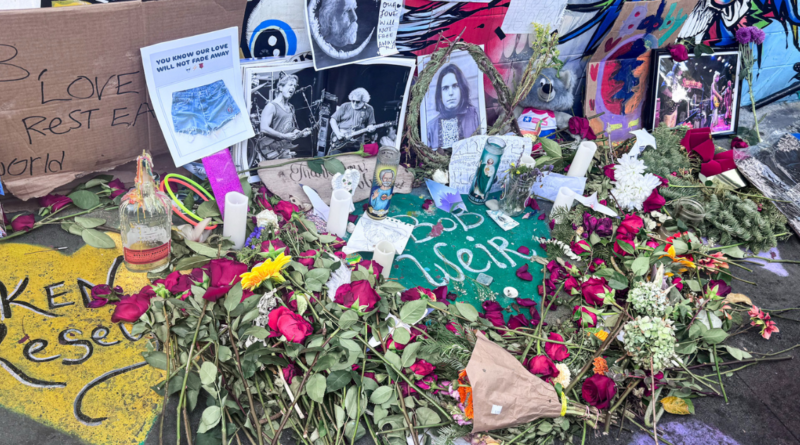
Appropriately, the venerable Bill Graham Civic Auditorium framed the festivities. A modest stage was erected on the lawn, showcasing one of Weir’s guitars crowned with his trademark Stetson hat. Nearby, an altar draped with Tibetan prayer flags held thousands of roses, blessings, notes, and offerings—further bridging the band’s lysergic Americana with the spiritual traditions Bobby had long absorbed. Against the stoic backdrop of City Hall, the space felt less like a dais and more like a sanctified grassroots rally.
Our group had a good vantage point about halfway back in the center. Slowly, the space filled up with thousands of mourners. I noticed a group of guys dressed in black suits fit for a funeral. A woman directly in front of me was wearing the first Dead shirt I ever owned back in 1991—a Loose Lucy graphic in the style of Charles Schulz’s Peanuts, hers adorned with yellow Wharf Rat flair. Volunteers distributed endless long-stemmed roses to the masses. Strangers were stopping strangers just to hug it out.
The ceremony began with a ten-minute opening ritual featuring four Buddhist monks offering Tibetan prayers. The presence of the Gyuto Foundation Monks was a deeply intentional tribute to a 40-year relationship between the monks and the Grateful Dead—their meditative, guttural throat singing intended to invoke deities, purify the space, and honor the cycle of life and death. Ven. Donyo, who led the memorial prayers, was part of a group of 22 monks who toured with the Grateful Dead in the late ’80s.
There was a series of speakers who offered poignant reflections and fond remembrances of their friend Bob. Several sent in touching video messages, including GD drummer Bill Kreutzmann, Dave Matthews, Trey Anastasio, Warren Haynes (who told a particularly humorous story), Bruce Hornsby (who invoked the obligatory McCoy Tyner comparison), Les Claypool and Larry LaLonde of Primus, Willie and Lukas Nelson, Don Was, and 49ers star George Kittle, among others. Sammy Hagar, one of Bobby’s good buddies over the past couple of decades, voiced a touching slideshow of candid photos from their colorful adventures and impromptu performances.
Homecoming: Celebrating The Life Of Bobby Weir
Naturally, the most impactful speeches were live and direct. Not the politicians present, per se, but the people who knew, sang, and made merry with Bobby through the years, miles, and milestones. A matriarch of the San Francisco sound, the Human Be-In, and Summer of Love, Joan Baez offered a testament to the folk roots and conscience at the core of the Grateful Dead’s embryonic era. Mickey Hart, the only band member to address the assembled, lovingly looked back at Bobby as a guiding force and told funny tales of yesteryear including a chemically-fueled field recording trip to the zoo.
Dressed in a sharp dark suit and appearing visibly shaken, John Mayer delivered a tearful, terrific eulogy mined directly from the heart. A later-in-life GD convert, Dead & Company’s virtuoso guitarist humbly acknowledged his own penchant to “sidle up next to whatever I’m in awe of.” With a quivering bottom lip, he declared, “Thank you, maestro. You changed my life. I will love you forever.” Often the punching bag for a certain segment of the Dead fanbase, on this day, John Mayer left nary a dry eye on the lawn. I suspect even Bill Graham himself would’ve shed a tear.
The same could be said for Bob’s two daughters, who each offered a monumental love letter to the man they knew not as our erstwhile psychedelic cowboy, but simply as “Dad.” Monét Weir peeled back the layers of the legend to reveal the woodshedding introvert and fiercely optimistic humanist. She shared intimate windows into a man who viewed political adversaries as pals, and believed American music could unite a fractured world.
Having spent years documenting her Dad’s twilight era through her own camera lens, Chloe Weir spoke with the poise of someone who understands that the music never stops—it only shifts between frequencies. She delivered a profound prophecy of cultural continuity, punctuated by her father’s pontification that Grateful Dead music would live on for the next 300 years. She proudly proclaimed that in three decades, a sixty-year-old head will still be flexing, “I saw them with Bobby,” a cheeky nod to the three decades of stodgy old Deadheads who say that regarding Garcia. Chloe spoke of her father’s devotion to the Azimuth, the liminal space where the music and masses meet. She posited that indeed this is not the end of the road, but the barefoot philosopher setting off again, forever a child of boundless seas.
Bobby’s wife, Natascha Weir—herself clearly nervous and wracked with acute grief—served as the service’s other spiritual anchor, blending tender reflections on intimate domesticity with the high-desert philosophy her husband lived by. Natascha addressed Bob as “teacher,” describing the duality of the quiet, meditative guru in their private life versus the fierce lion, force-of-nature presence we knew on stage. In a move that pushed the crowd into a collective meditation, she requested exactly 108 seconds of silence, noting that Bob cherished the number 108 and loved to “push limits.”
Natascha was the first to point out a hawk that had been circling above the area for several minutes. We all took a “Holy Instant” followed by a “Bobby Bow” and screamed skyward as the winged wonder landed on the roof before soaring around the City Hall dome. The magnificent creature represented a final flight of the seabird, a poetic benediction from the naturalist now going to heaven.
Natascha, her daughters, Joan Baez, and eventually a large swath of family and friends took the stage behind John Mayer—playing Bobby’s beloved acoustic—for a tear-jerking singalong of “Ripple”. Recorded just a few blocks away at Wally Heider Studios on Hyde Street, the American Beauty chestnut reinforced the family’s message that Grateful Dead music belongs to the community now more than ever. “If I knew the way, I would take you home.”
Following the heavy afternoon memorial at Civic Center Plaza, I felt called to head back to Oakland to spend time with my newborn son and wife. But just before showtime, I was notified that a ticket was available to cover this cosmic convergence for Ace. I swiftly hopped in my wook whip and did the Richard Petty over the Bay Bridge into what used to be the heart of town.
Upon arrival, I was benevolently furnished with one of the greatest seats I’ve ever had at any show, let alone an event and venue of this magnitude: first row of the lower loge, dead center with an unobstructed view of the whole shebang from above. When the staff member scanned me in, he deadpanned: “You know, that’s the best seat in the house.” When I finally made my way to the spot, it was clear the dude was not kidding.
Howling Wolves: A Tribute to Bobby Weir – The Warfield – San Francisco, CA – 1/18/26
For over three thrilling hours, the hallowed halls of the Warfield were transformed into a healing sanctuary; Howling Wolves: A Tribute to Bobby Weir took us even higher. The last-minute, sold-out family affair was ostensibly a benefit for the Furthur Foundation. More than just a goodbye concert, the sprawling ensemble unfurled a soul-stirring sojourn for a community still reeling from the loss of an icon.
Grahame Lesh anchored an elastic house band that served as a mutating museum of Bobby’s varied archetypes and eras. Sometimes boasting over 15 musicians at once, Howling Wolves embodied a living tapestry of the Dead’s multi-generational lineage and exponential tentacles.
While I intended (and attempted) to take studious notes, the emotional quotient was running hot and heavy as this mourning music filled the air. Within a few songs, it became a futile endeavor; this would be less about keeping a tight scorecard and more just letting go and surrendering to the flow. The night was filled with a thousand stars; what follows are everlasting moments that will stick with me forever.
View this post on Instagram
An evening focusing on Bobby’s voluminous canon and certified classics, the show began with an instrumental “Cassidy”, where the audience’s collective voice filled the gaping void left by Weir’s absence. After a rollicking “Playin’ in the Band”, Grahame led the entire ensemble into a glorious reading of “Uncle John’s Band”, brimming with (at least) half-a-dozen stacked vocal harmonies and all the fixins raining down upon thee, the first of several full-throated singalongs that shook the Warfield balcony—as did the first section of “The Other One”, with vocals shared between Lesh and Jason Crosby. Oteil Burbridge uncorked some massive “Phil bombs” that would tremble, then explode into smoking craters to blow our minds.
Wielding a guitar, Reed Mathis stepped up for a particularly potent interpolation of “Black-Throated Wind”, putting his Oklahoma-by-way-of-the-East-Bay sauce on this weathered Weir/Barlow ode to the road. A hushed, staggering moment materialized when 94-year-old troubadour Ramblin’ Jack Elliott took the stage, spinning yarns and yodeling while backed by bassist Paul Knight. Elliot’s “Waiting for a Train” rooted the room in the frontier-folk traditions Bobby crawled inside of until his very end of days.
Crosby piloted a snake-charming saunter through the obtuse prog-reggae “Estimated Prophet”, a buoyant reading of the late ’70s spitter with a sweet Adam Theis trombone solo. The keyboardist detoured through a verse of Pink Floyd’s ubiquitous “Money” before segueing back into the only Bobby banger in 7/4 time.
Vocalists Sunshine Becker and Elliott Peck each brought stunning, iridescent backing harmonies throughout the evening. Peck’s duet with Lesh on “The Music Never Stopped” was exhilarating; Becker provided a heart-filling “Bird Song” sung for Bobby, featuring soaring soprano sax courtesy of Dave Ellis reminiscent of the Spring 1990 sound.
A sturdy anchor all night long, Burbridge unleashed throbbing, melodic rolling thunder, occasionally spelled by Pete Sears. The rotating double drum thrones featuring John Molo, John Kimock, and Alex Koford kept the polyrhythmic engine humming. Barry Sless and Greg Leisz infused the air with that cosmic-country pedal steel shimmer. The divine Holly Bowling wowed us all night; she and Crosby wove intricate ivory webs on various keyboards stage right. The Wolf Pack (Brian Switzer, Adam Theis, and Alex Kelly) added a brassy, cinematic punch that recalled the late-era Weir brotherly excursions. Lead guitars and occasional lead vocals were admirably and respectfully handled by Lesh, Mark Karan, Stu Allen, Dan “Lebo” Lebowitz, Mathis, and Sless.
During the set break, I marveled at how this enormous ensemble could coalesce and coagulate so freely. Each player connected to the greater GD family, speaking the same language with different accents, all in fantastically filial tradition. The Howling Wolves could seamlessly oscillate from screaming “Primal Dead” to celestial Fall ’73, to Brent swan-song/Branford bliss, to late-period Bobby as a shaman on the frontier—all while simultaneously reimagining the Great American Songbook yet again in fresh, invigorating fashion. While the night was focused on Weir, with Grahame at the wheel there was most certainly Phil Lesh’s friendly spirit of eclectic co-conspirators and fearless improvisational adventure at the core of the evening’s modus operandi.
And your humble narrator was pinching himself, soaking it all in solo, from the best seat in the house that Garcia built.
View this post on Instagram
The second frame blasted off into the ether with a euphoric, downright healing “Jack Straw”, an anthemic gallop before dissolving into a gargantuan, segued trifecta. “The Other One” thumped with Burbridge’s cataclysmic Phil bombs threatening the theater’s structural integrity. “Dark Star” soared into the cosmos, kaleidoscopic voyaging, aural Fibonacci sequences, and further spine-tingling full-theater singalongs that melted most beating hearts in the building. Lovingly rendered in patient, ornate grandiosity, “Terrapin Station” was trotted out as a suite, three scintillating sections in the shadow of the Mission moonlight, building and bouldering to an exuberantly belted climax that induced full-body goosebumps.
A celebratory romp through the obligatory “Truckin'” with a (possibly audibled on the fly) “Cassidy” reprise/outro closed the incendiary second set with jubilant authority. An appropriate, emotional encore of “Sugar Magnolia” > “Sunshine Daydream” was led by Jackie Greene. Then, a room-shaking “Not Fade Away”, buttressed by a complete Wolves squadron, sang us all the way back home with a most familiar, fateful tune.
View this post on Instagram
With that, Grahame Lesh thanked the band, the crowd hooted and hollered, and everybody saluted the dearly departed. Stragglers in disbelief did the NFA clap for as long as they could. Well after 2:00 in the morning, the Warfield house lights came up. We spilled out onto Market Street and into the San Francisco night, having just been blessed by the best in town.
Sayonara, Bobby Weir: the kid, maestro, teacher, partner, father, foil, cowboy, guru, shaman, seeker—the last keeper of the Azimuth, and forever an outlaw champion in our eyes.
Words: B.Getz
Howling Wolves are:
Grahame Lesh: Guitar and vocals (Midnight North)
Oteil Burbridge: Bass (Dead & Company)
John Molo: Drums (Phil & Friends/The Other Ones)
Jason Crosby: Keyboards
Holly Bowling: Keyboards/Piano
Barry Sless: Guitar/Pedal steel
Greg Leisz: Pedal steel (Wolf Brothers)
Stu Allen: Guitar (Phil & Friends)
Mark Karan: Guitar (RatDog, The Other Ones)
Pete Sears: Bass (Jefferson Starship, Moonalice)
John Morgan Kimock: Drums
Alex Koford: Drums (Terrapin Family Band)
Sunshine Becker: Vocals (Furthur)
Elliott Peck: Vocals (Midnight North)
The Wolf Pack (Horns & Strings)
Dave Ellis: Saxophone (RatDog)
Brian Switzer: Trumpet
Adam Theis: Trombone (Jazz Mafia)
Alex Kelly: Cello
Sheldon Brown: Saxophone
Special Guest Appearances:
Ramblin’ Jack Elliott: Vocals/Guitar (performed “Waiting for a Train”)
Jackie Greene: Vocals/Guitar (performed “Jack Straw” and “Sugar Magnolia”)
Reed Mathis: Vocals/Guitar (performed “Black Throated Wind”)
Dan “Lebo” Lebowitz: Guitar and Pedal steel (ALO)
Paul Knight: Bass (with Ramblin’ Jack Elliott)
Set I:
Cassidy: Instrumental (with crowd singalong)
Playing in the Band >: Grahame Lesh
Uncle John’s Band: Grahame Lesh and full ensemble
Estimated Prophet > : Jason Crosby (with Pink Floyd “Money”)
The Other One (Verse 1): Grahame Lesh and Jason Crosby
Waiting for a Train: Ramblin’ Jack Elliott
Bird Song: Sunshine Becker
Black Throated Wind: Reed Mathis
New Minglewood Blues: Mark Karan
The Music Never Stopped: Grahame Lesh and Elliott Peck
Set II:
Jack Straw: Jackie Greene (with Stu Allen)
Dark Star>: Jackie Greene
The Other One (Verse 2) > : Jackie Greene
Terrapin Station: Stu Allen, Oteil Burbridge, and Grahame Lesh
Playing in the Band (Reprise): Grahame Lesh
Truckin’ / Cassidy (outro): Grahame Lesh and full ensemble
Encore:
Sugar Magnolia / Sunshine Daydream: Jackie Greene
Not Fade Away: Full Ensemble (with crowd singalong)